
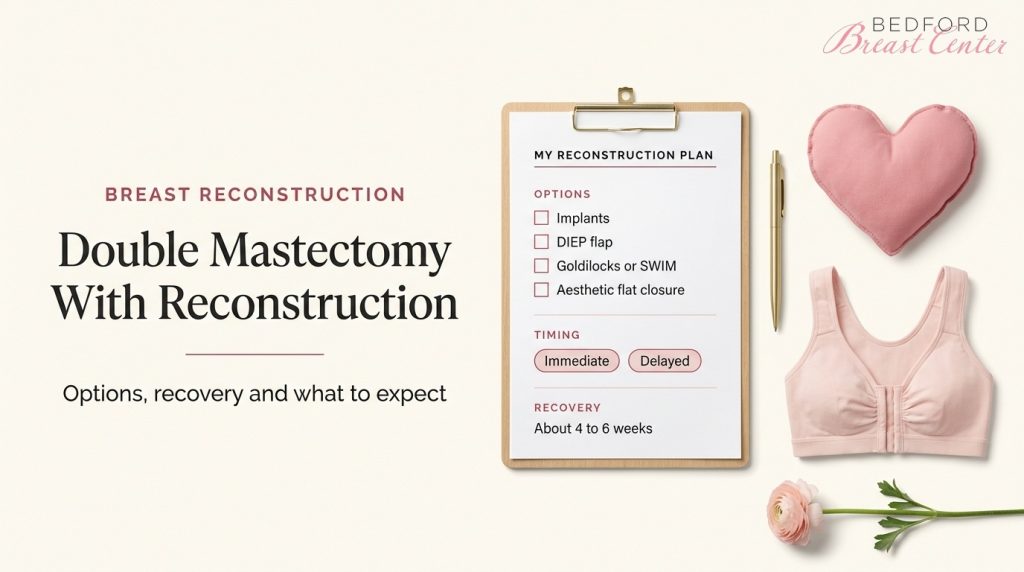
Deciding to remove both breasts is a big step, and the choices about rebuilding them can feel just as heavy. A double mastectomy with reconstruction removes both breasts and rebuilds their shape, either in the same operation or later, using implants, your own tissue, or a mix of both.
Some women reach this after cancer in one breast; others after a genetic test shows high inherited risk. Either way, double mastectomy reconstruction has improved, and many now wake up with a breast shape in place.
Good results depend on planning, so Bedford Breast Center maps your double mastectomy surgery and reconstruction together.
Key Takeaways
- A double mastectomy with reconstruction removes both breasts and rebuilds their shape using implants, your own tissue, or your remaining breast skin and fat.
- A double mastectomy and immediate reconstruction happen in one operation. Delayed reconstruction waits months or years, usually until radiation is finished.
- Does a double mastectomy prevent breast cancer? It lowers risk by 90% or more in high-risk women, but a thin layer of breast tissue can remain.
- Recovery time for double mastectomy with immediate reconstruction usually means 1 to 2 weeks with drains and 4 to 6 weeks of lifting limits, longer after flap surgery.
- Double mastectomy with reconstruction insurance coverage is federally required for most plans that cover mastectomy, including breast prostheses and treatment of complications.
What Is a Double Mastectomy With Reconstruction?
A double mastectomy with reconstruction is surgery to remove both breasts, called a bilateral mastectomy, and rebuild their shape. That rebuilding can start in the same operation, known as immediate reconstruction, or months to years later, known as delayed reconstruction.
Most women arrive from one of two places. Some have cancer in one breast and choose to remove the healthy breast too, which doctors call a contralateral prophylactic mastectomy. Others carry a BRCA1 or BRCA2 mutation, or have a strong family history, so they choose the surgery to lower their risk.
Either way, a bilateral mastectomy with reconstruction takes two surgeons. Your breast surgeon removes the tissue, then your reconstructive surgeon rebuilds the shape, both in the same trip to the operating room.
Why Are More Women Choosing a Double Mastectomy With Reconstruction?
Twenty years ago, rebuilding usually came later. Today it often happens in the same operation, and a study in the Journal of Clinical Medicine found that breast reconstructions in the US rose from 106,338 in 2015 to 151,641 in 2022, with roughly three in four done immediately.
Those numbers cover all reconstruction, not just double mastectomy reconstruction.
Still, they show how normal immediate rebuilding has become, which is why you can now realistically ask for both in one surgery.
Women give three reasons most often:
- Genetic results: A BRCA mutation raises lifetime risk, and when to consider preventive surgery usually comes down to your age and family plans.
- Symmetry: Rebuilding both breasts together makes size and shape far easier to match.
- Peace of mind: Worry about a second cancer is a valid reason, even when the medical benefit is small.
Does a Double Mastectomy Prevent Breast Cancer?
Not completely, though it lowers the risk a great deal. The American Cancer Society reports that preventive mastectomy can lower your risk by 90% or more.
So can you get breast cancer after a double mastectomy? Yes, though rarely, because surgeons cannot remove every breast cell. The few that remain can still turn cancerous, which is why follow-up visits and noticing chest changes still matter.
The maths looks different if you already have cancer. Say you have it in one breast, with no family history and no genetic risk. Removing the healthy breast would lower your chance of a second cancer, but the American Cancer Society reports that it does not help most women in that position live longer.
Your chance of cancer in that other breast was low to begin with, and most women guess it far too high.
Reconstruction Options After a Double Mastectomy
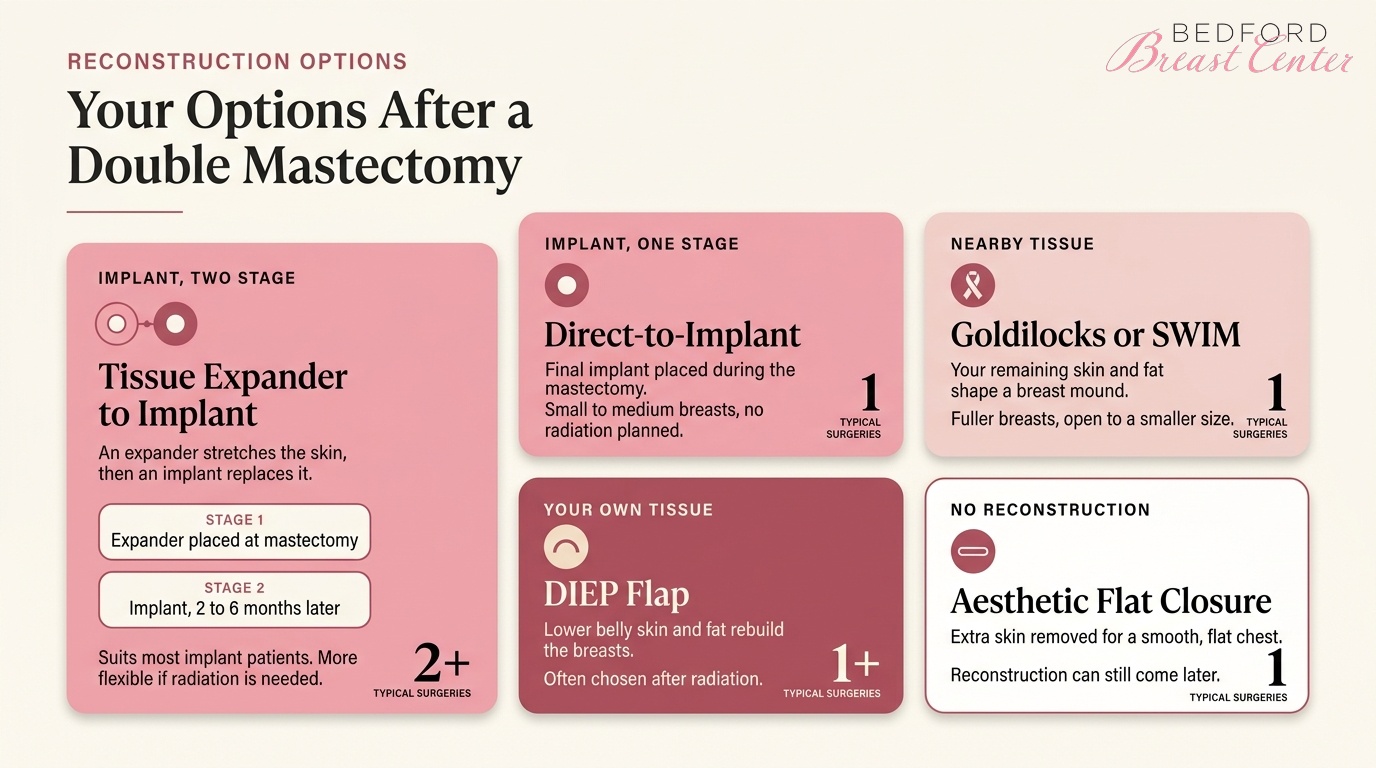
Breast reconstruction after double mastectomy uses implants, your own tissue (a flap), techniques that reshape your remaining breast skin and fat, or no reconstruction at all.
Which option fits you isn't really a matter of preference. The National Cancer Institute lists the factors that decide it: your breast size and shape, your age and health, past surgeries, whether you need radiation, and how much of your own tissue is available.
So it helps to arrive at your consultation knowing what is on the table:
|
Option |
How it works |
Typical surgeries |
Often suited to |
|
Direct-to-implant (one stage) |
An implant is placed during the mastectomy |
Usually 1 |
Small to medium breasts, healthy skin, no radiation planned |
|
Tissue expander to implant (two stage) |
An expander stretches the skin, then is swapped for an implant 2 to 6 months later |
2 or more |
Most implant patients; more flexible if radiation is needed |
|
DIEP flap (your own tissue) |
Skin and fat from the lower belly rebuild the breasts |
1, often plus a revision |
Enough belly tissue, no major past abdominal surgery; often chosen after radiation |
|
Goldilocks or SWIM (nearby tissue) |
Remaining breast skin and fat are shaped into a breast mound |
Usually 1 |
Fuller breasts; open to a smaller size; wants to avoid implants and flaps |
|
Aesthetic flat closure |
Extra skin and tissue are removed, then the chest is tightened and smoothed |
1 |
Wants no reconstruction or fewer operations |
Your surgeon will narrow this list once she has seen your skin and your treatment plan, though reading who suits each technique first makes that conversation shorter.
Implant Reconstruction
Implants are the most common route, and the real choice here is how many operations you want.
Two-stage reconstruction places a tissue expander first, stretching your skin over several weeks before a permanent implant replaces it 2 to 6 months later. Direct-to-implant skips that step, putting the final implant in during the mastectomy itself.
Either way, a double mastectomy with implants means a shorter operation and quicker recovery than flap surgery. Most implants now sit above the chest muscle, which usually means less muscle pain, though implants may need replacing someday.
Flap Reconstruction Using Your Own Tissue
A flap uses your own body to rebuild the breast, which is why it behaves like the tissue it replaces.
In a double mastectomy with DIEP flap reconstruction, skin and fat from your lower belly rebuild both breasts, and your abdominal muscle stays where it is. Tissue can also come from your back, thighs, or buttocks.
The result feels soft and warm, and it changes with your weight. What you trade for that is a longer operation, a longer hospital stay, and a second scar, though flaps are often the better option after radiation.
Nipple-Sparing, Goldilocks, SWIM and Sensation-Preserving Options
These four techniques share one idea: keep more of what is already yours.
A nipple-sparing mastectomy removes the breast tissue while keeping your skin and nipple, so a double mastectomy with nipple sparing can look more like you did before. The other three go further:
- Goldilocks mastectomy: Shapes your remaining breast skin and fat into a smaller breast, with no implant or flap.
- SWIM reconstruction: Builds a breast from nearby tissue, also without implants or distant flaps.
- Sensation-preserving mastectomy: Reconnects nerves during surgery, aiming to bring some feeling back over 6 to 12 months.
Candidacy depends on your breast size, your skin, and where the cancer sits, so ask your surgeon which of these apply to you.
Choosing Not to Have Reconstruction
Plenty of women skip reconstruction and are glad they did.
Aesthetic flat closure is its own procedure: your surgeon removes extra skin and tissue, then tightens and smooths the chest wall so it sits flat. Simply skipping reconstruction won't produce that result, which is why you have to ask for it by name.
The trade is fewer operations and a shorter recovery. Nothing closes either, since breast reconstruction after double mastectomy can still happen later if you change your mind.
Immediate vs Delayed Reconstruction
This one usually comes down to radiation.
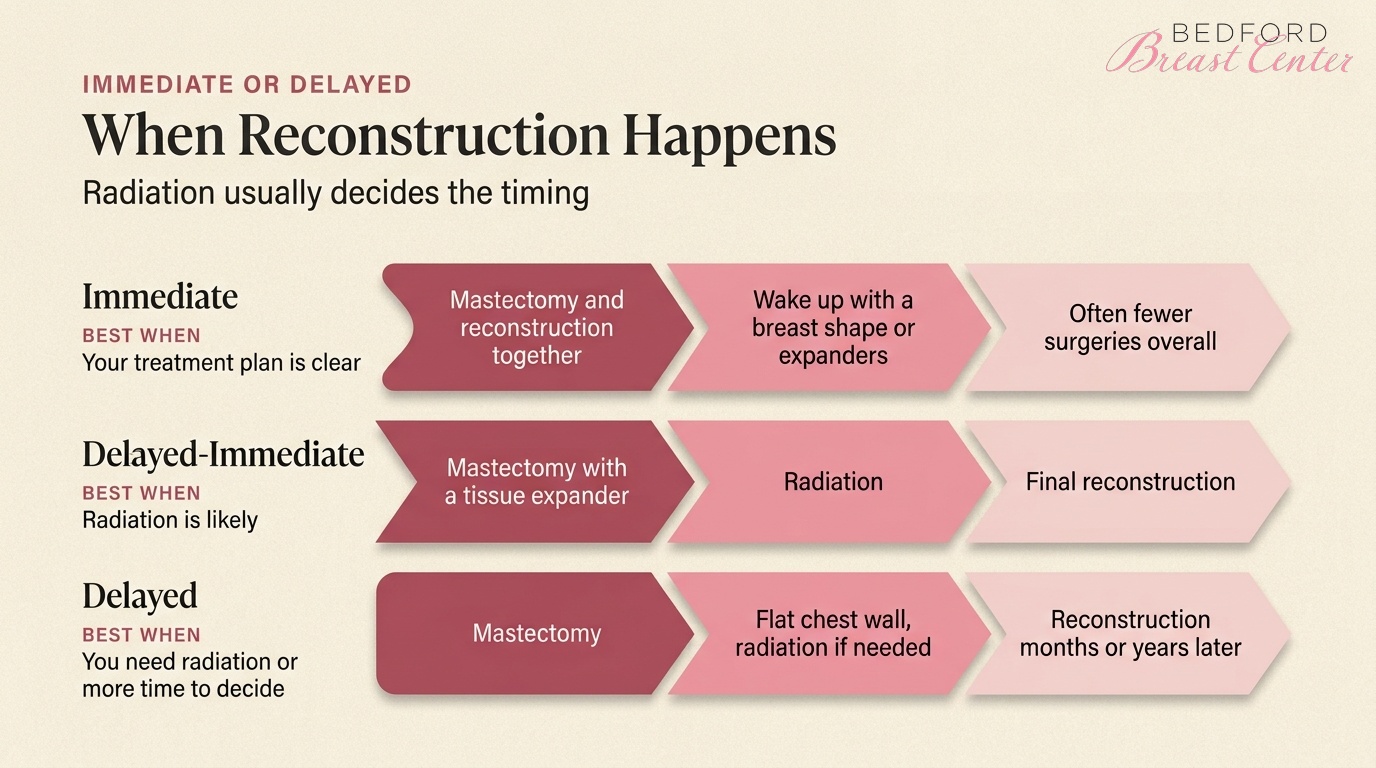
With a double mastectomy and immediate reconstruction, rebuilding starts during the mastectomy, so you wake up with a breast shape or tissue expanders already in place. Delayed reconstruction waits months or years, most often until radiation is finished.
|
Immediate reconstruction |
Delayed reconstruction |
|
|---|---|---|
|
When |
During the mastectomy |
Months or years later |
|
You wake up with |
A breast shape or expanders in place |
A flat chest wall |
|
Radiation |
Still possible, but it can affect results, especially with implants |
Often chosen when radiation is likely |
|
Surgeries |
Often fewer overall |
At least one more operation |
|
A good fit when |
Your treatment plan is clear |
You need radiation or more time to decide |
Immediate is the more common route, particularly when surgery is preventive and no radiation is planned. If radiation is likely, though, your surgeon may suggest a middle path: an expander holds your skin open during the mastectomy, and the final double mastectomy reconstruction waits until radiation is done.
What to Expect From Surgery and Recovery
Most of what worries people about this surgery turns out to be the practical stuff.
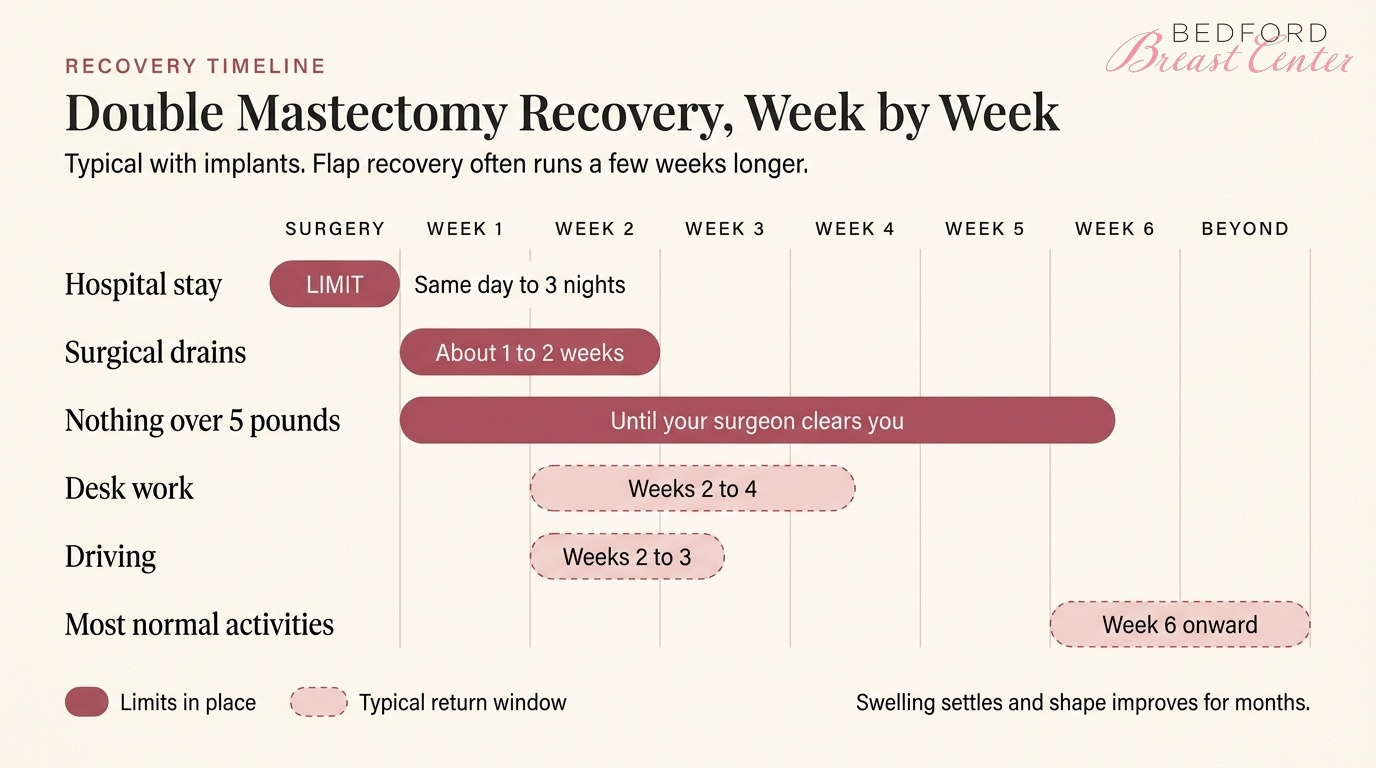
A double mastectomy with reconstructive surgery usually takes several hours. You will likely go home within a few days, and your drains stay in for roughly 1 to 2 weeks. How long each stage lasts depends on the reconstruction you choose, so the sections below cover the day itself, the hospital stay, and the weeks that follow.
On the Day of Surgery
Most of the day is spent waiting and being prepared, not in surgery.
Breastcancer.org reports that reconstruction with tissue expanders or implants takes about three to four hours, while flap reconstruction runs six to eight. Here is how the day of double mastectomy with reconstruction surgery usually unfolds:
- Check-in and marking: Your surgeons review the plan and mark your incisions while you sit upright.
- Anesthesia: You are fully asleep throughout.
- Mastectomy: The breast surgeon removes the breast tissue on both sides.
- Lymph nodes: A few underarm nodes are usually removed and checked for cancer.
- Reconstruction: Expanders or implants are placed, or your own tissue is shaped.
- Recovery room: You wake up with dressings, a surgical bra, and drains.
Hospital Stay and Surgical Drains
Knowing how the drains work makes the first two weeks much easier.
After a bilateral mastectomy with reconstruction, implant patients sometimes go home the same day, while flap patients usually stay two to five days so the team can check blood flow to the tissue.
You leave with thin tubes that carry fluid from the surgical area into small bulbs. They come out at a follow-up visit 1 to 2 weeks later, and until then you empty the bulbs a few times a day, record the amounts, and keep the tube sites clean.
None of it is difficult. Front-closing tops and a lanyard for the bulbs make those days much easier.
Double Mastectomy With Reconstruction Recovery Timeline
Recovery happens in stages, and knowing which stage you are in stops the slow weeks from feeling like setbacks. Recovery time for double mastectomy with immediate reconstruction is usually shorter with implants than with flaps, since flap surgery also has to heal where the tissue was taken.
|
Timeframe |
What is typical |
|---|---|
|
Hospital stay |
Same day to about 3 nights with implants; 2 to 5 days with flaps |
|
Weeks 1 to 2 |
Drains in, limited arm movement, help at home, a follow-up visit |
|
Weeks 3 to 6 |
Light daily activities and desk work; nothing over 5 pounds until your surgeon clears you |
|
Week 6 and beyond |
Most normal activities return; swelling settles and shape keeps improving for months |
Two questions come up constantly. Most people are back at a desk job in 2 to 4 weeks, and driving usually resumes around week 2 or 3, once you are off prescription pain medication.
Recovery after a double mastectomy with DIEP flap reconstruction often runs a few weeks longer, so build that into the time you book off work.
What Do Breasts Look Like After Reconstruction?
They will look like breasts, though not quite like the ones you had.
Technique decides most of it, which is why double mastectomy before and after photos vary so much. Implants give a rounder, fuller shape, particularly at the top. Flaps and nearby-tissue techniques look and feel softer, and scars fade and flatten over a year or more.
Nipples are their own question. After a double mastectomy with nipple sparing, yours stay in place, and if they are removed, nipple reconstruction or a realistic 3-D tattoo can finish the look.
Feeling is the part people are least prepared for. Your breasts will be numb or much less sensitive afterward, since the nerves are cut during surgery, though some sensation can return as they regrow.
The photos below show nipple-sparing surgery with one-stage implant reconstruction.
Risks and Possible Complications
Most people heal well after a double mastectomy with reconstructive surgery, and part of the risk is within your control. The rest falls into three groups:
- General risks. Bleeding, infection, fluid buildup (seroma), blood clots, slow wound healing, and numbness.
- Implant risks. Hardening scar tissue (capsular contracture), rupture, shifting and, rarely, a lymphoma linked to textured implants (BIA-ALCL).
- Flap risks. Partial or complete flap loss, firm areas of fat, and problems where the tissue was taken, such as belly weakness.
Smoking, diabetes, and obesity raise the complication rate whichever option you choose, which is why your surgeon asks about all three.
Longer term, implants may need replacing, while a double mastectomy with DIEP flap reconstruction means a bigger operation up front but tends to last. Weighing DIEP flap vs. implant reconstruction is how most people settle it, and revision surgery can adjust shape or symmetry later.
Is a Double Mastectomy Right for You?
It depends on how high your risk of a second cancer really is.
If you have a BRCA mutation or a very strong family history, that risk is high, and removing both breasts cuts it sharply. If you have cancer in one breast and average risk otherwise, the risk is already small, so a bilateral mastectomy with reconstruction mostly buys symmetry and peace of mind, and costs you a longer recovery.
Worried you might regret it? The research is reassuring. A 2026 study in the Annals of Surgical Oncology followed 217 women with cancer in one breast and no inherited mutation, and found that choosing a bilateral mastectomy was not linked to higher regret. Regret clustered instead among women who removed one breast when a lumpectomy would have sufficed.
Comparing single vs double mastectomy helps sort out what matters most to you. Then bring these to your surgeon:
- Can you get breast cancer after a double mastectomy, given your history?
- Would radiation change your reconstruction plan?
- Which approach to breast reconstruction after double mastectomy suits your body?
- Are you a candidate for a double mastectomy with nipple sparing?
- Can you see double mastectomy before and after photos of patients with a similar build?
Insurance Coverage and Cost
Reconstruction is not treated as cosmetic surgery, and federal law says so.
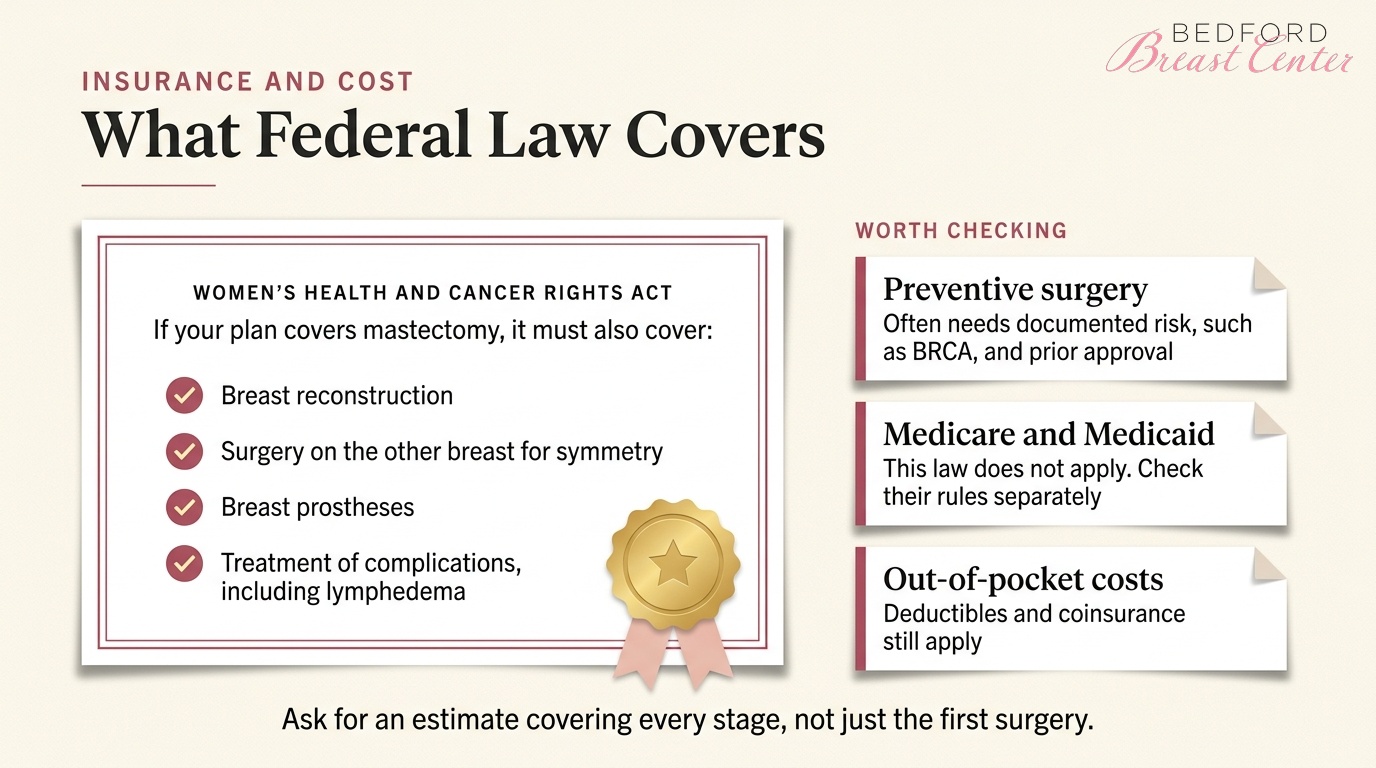
Under the Women's Health and Cancer Rights Act, plans that cover mastectomy must also cover reconstruction, symmetry surgery on the other breast, breast prostheses, and treatment of complications, including lymphedema.
Still, double mastectomy with reconstruction insurance coverage has three gaps worth checking:
- Surgery to lower risk: Coverage usually depends on documented risk, such as a BRCA mutation, and often needs prior authorization.
- Medicare and Medicaid: The federal law does not apply to either. Medicare may cover reconstruction, while Medicaid varies by state.
- Out-of-pocket costs: Deductibles, coinsurance, and out-of-network charges still apply.
The cost of double mastectomy reconstruction varies by technique, number of operations, and facility, so ask for an estimate covering every stage, not just the first surgery.
Wondering Which Reconstruction Option Fits You?
Choosing a double mastectomy with reconstruction means weighing cancer risk, recovery, and how you want to feel in your body afterward. You do not have to decide alone.
At Bedford Breast Center, Dr. Heather Richardson, who co-developed the Goldilocks mastectomy, and Dr. Leslie Memsic work alongside our plastic surgeons, so your mastectomy and reconstruction are planned as one. Bring your list of questions to your consultation.
Call (310) 278-8590 to reach our Beverly Hills team, or meet our breast surgeons.
Frequently Asked Questions
How long does a double mastectomy with reconstruction take?
Double mastectomy with reconstruction surgery usually takes about 3 to 8 hours, depending on the type of reconstruction. With tissue expanders or implants, it often takes 3 to 4 hours, while flap reconstruction takes about 6 to 8 hours. Ask your surgical team for an estimate based on your plan.
How painful is a double mastectomy with reconstruction?
Most people feel soreness, tightness, and pulling across the chest rather than sharp pain, and it is worst in the first few days. Implants placed under the chest muscle can cause spasms, and flap surgery adds a second sore area where tissue was taken. Prescribed pain medicine usually keeps it manageable.
Can you get breast cancer after a double mastectomy?
Yes, but it is uncommon. A double mastectomy removes most breast tissue, not every cell, so a small risk remains in what is left behind. Keep your follow-up visits, and report any new lump, skin change, or swelling on your chest or under your arm to your care team.
Will you have feeling in your breasts after reconstruction?
Usually less than before. Most people lose some or all feeling in the breast skin and nipples, because nerves are cut during a mastectomy. Some sensation can return over months to years. Sensation-preserving techniques reconnect nerves during surgery and may help more feeling return, so ask whether you qualify.
What is the hardest part of recovery after a double mastectomy?
For most people, the first one to two weeks. Surgical drains, limited arm movement, tiredness, and needing help with everyday tasks make that stretch the most frustrating part of double mastectomy with reconstruction recovery.
Emotional adjustment can take longer than physical healing, and a support group can help.
Is reconstruction after a double mastectomy worth it?
It depends on your priorities, and there is no wrong answer. Many women say reconstruction helps them feel like themselves again, while others prefer going flat and avoiding extra surgery. Reconstruction after a double mastectomy can also be delayed, so you do not have to decide everything before your mastectomy.
Does insurance cover a double mastectomy with reconstruction?
Usually, yes. The Women's Health and Cancer Rights Act requires plans that cover mastectomy to cover reconstruction, prostheses and complications.
Coverage for a preventive double mastectomy with reconstruction often requires documented risk, such as a BRCA mutation. Medicare and Medicaid follow different rules, so check with your insurer first.
How long is recovery after a double mastectomy with reconstruction?
Most people need about 4 to 6 weeks before returning to normal activities.
Recovery time for double mastectomy with immediate reconstruction is shortest with implants, and drains usually come out in 1 to 2 weeks. A double mastectomy with DIEP flap reconstruction usually adds a few more weeks, since the belly also heals.
What is a bilateral mastectomy with reconstruction?
A bilateral mastectomy with reconstruction is the medical name for a double mastectomy with reconstruction: both breasts are removed and rebuilt, either in the same operation or later. Rebuilding can use implants, your own tissue or your remaining breast skin and fat, and a breast surgeon and plastic surgeon usually work together.

Leave a Reply