
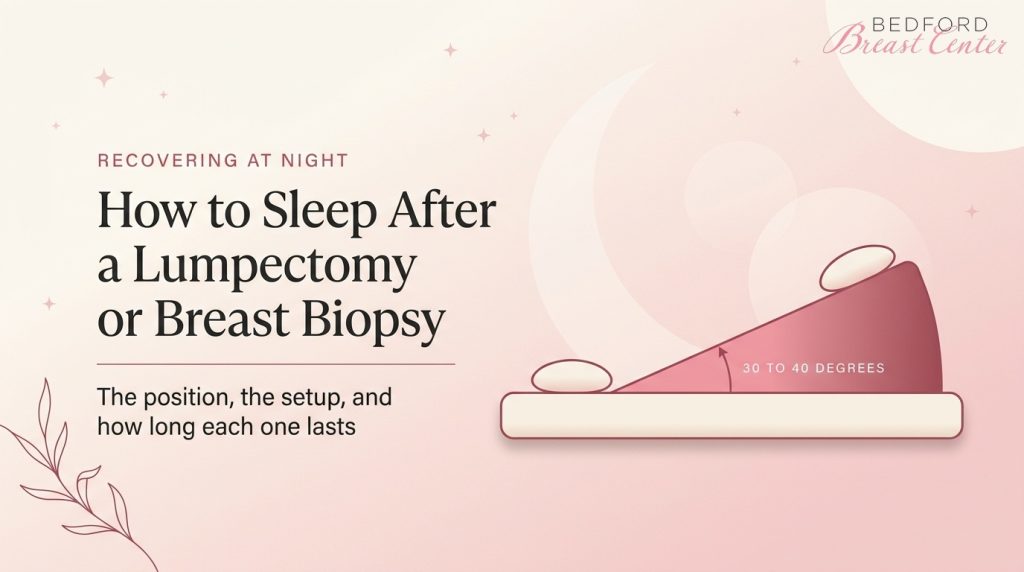
Nobody warns you that the hardest part of recovery happens at night. You lie flat, sore, turning carefully, and every position pulls at the same tender spot.
The good news is that most patients sleep well again within a few nights. Getting there costs nothing. The best sleeping position after breast biopsy or lumpectomy is flat on your back, upper body raised.
Still, recovery should feel easier each night. If pain worsens, you develop spreading redness, or you develop a fever, call your care team. The breast surgeons at Bedford Breast Center walk you through recovery before you go home, sleep included.
Key Takeaways
- How to sleep after a lumpectomy comes down to one position: on your back, upper body raised 30 to 40 degrees. That is the best sleeping position after breast surgery generally, and it applies after a biopsy too.
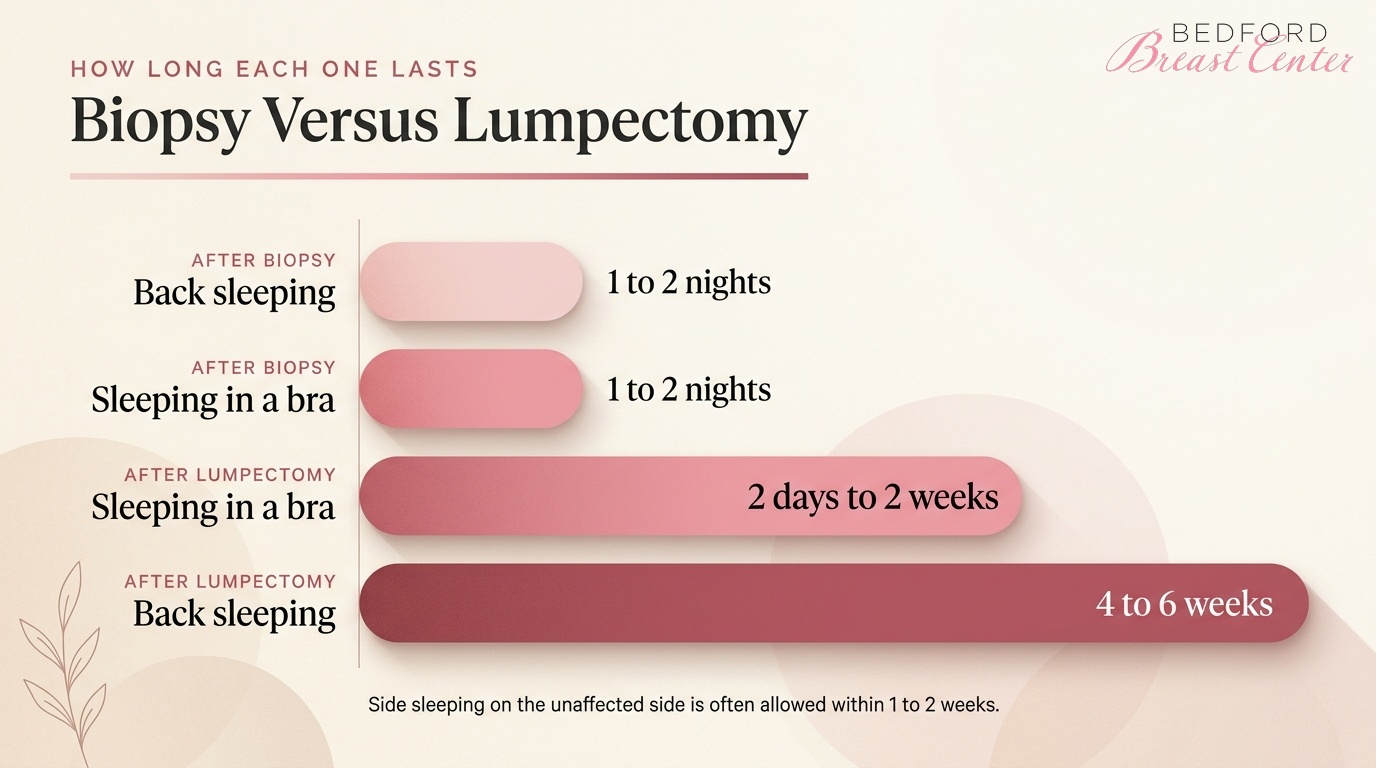
- Expect to sleep on your back for 4 to 6 weeks after a lumpectomy, with side sleeping on the unaffected side allowed sooner.
- Your sleeping position after a breast biopsy matters for a night or two, not a month.
- How long to sleep in a bra after a lumpectomy runs from 2 to 3 days up to 2 weeks or more.
- How long to rest after a lumpectomy: plan on 1 to 2 weeks, with a gradual return to normal activity after that.
- Call your breast care team for fever, spreading redness, discharge, or worsening pain.
What Is the Best Sleeping Position After a Lumpectomy?
The best sleeping position after a lumpectomy is flat on your back, with your head and chest raised 30 to 40 degrees on a wedge or a stack of firm pillows. Most surgeons ask you to hold that angle for 4 to 6 weeks.
That angle does real work. When you raise your chest above your heart, fluid drains away instead of pooling, which limits the swelling and bruising that peak early.
Lying flat, by contrast, lets the weight of your breast pull sideways on tissue that is knitting together.
Why Sleep Matters for Lumpectomy Recovery
Sleep is when your body does most of its repair work. During deep sleep, growth hormone release rises, inflammation settles, and your immune system gets what it needs to protect a fresh incision.
Surgery makes that harder at the worst possible moment. Writing in Scientific Reports, researchers who surveyed 400 elective surgery patients, all of whom slept normally beforehand, found that 65 percent had moderate to severe sleep disturbance two days after surgery. The more pain patients reported, the worse their sleep, which is why the authors urge treating pain early.
So how to sleep after a lumpectomy is a clinical question, not a comfort one. Often, the position you choose is what lets your pain medication work.
How Do You Sleep After Breast Lump Removal?
Sleeping after breast lump removal comes down to five things you set up once and repeat nightly. Because a lumpectomy removes the tumor along with a margin of tissue, every step below keeps that area from being stretched or compressed overnight.
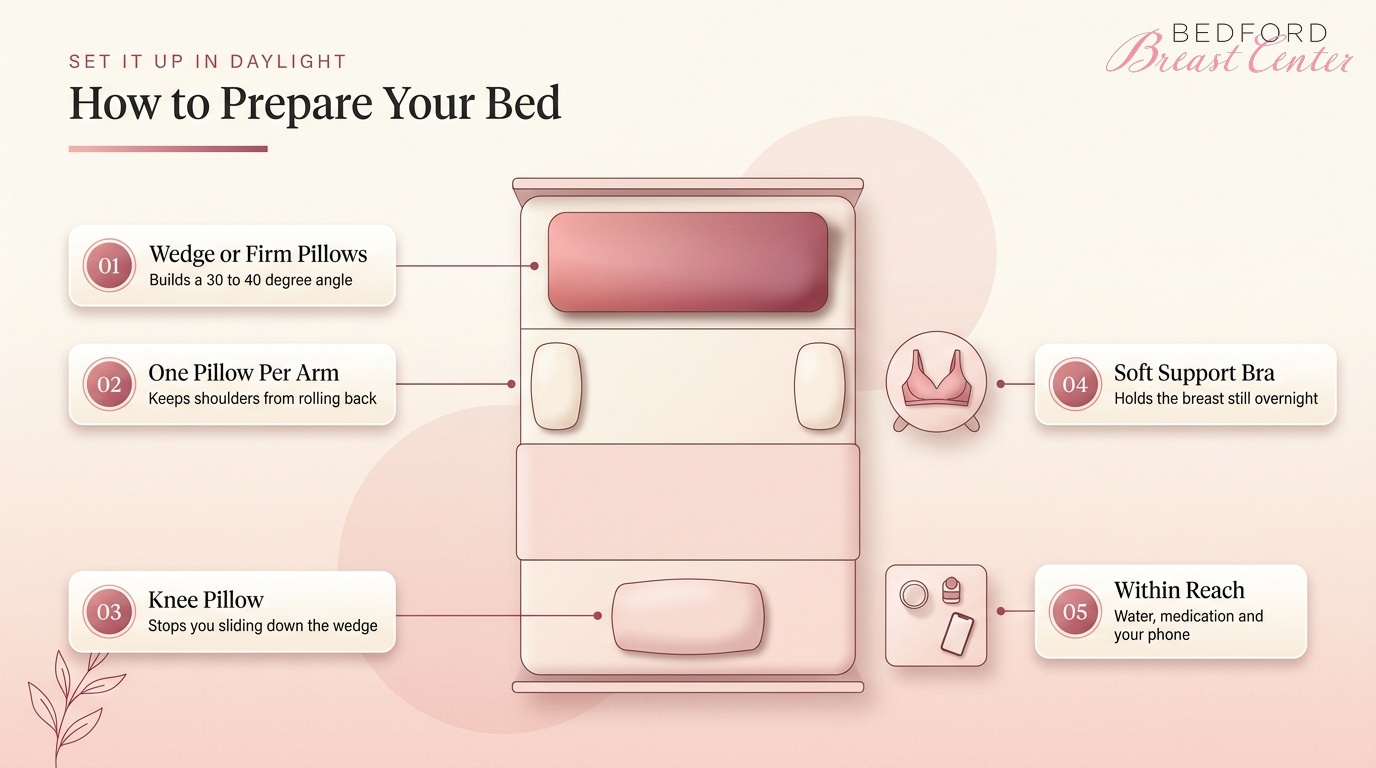
- Build the angle. Stack two to three firm pillows, or use a wedge, so your upper body sits at 30 to 40 degrees. The slope should begin at your lower back, not your neck.
- Support both arms. A pillow under each forearm keeps your elbows forward and stops your shoulders rolling back across your chest.
- Add a knee pillow. It keeps you from sliding down the wedge, the usual reason patients wake up flat and sore.
- Keep your support bra on. A soft bra holds the breast still so it does not shift when you move.
- Get in and out sideways. Sit on the edge of the bed, lower onto your side using your legs, and roll onto your back. Pushing upright with your arms strains the chest wall.
Easiest of all, a recliner holds the angle, which is where how to sleep after a lumpectomy often starts.
When Can You Sleep on Your Side After a Lumpectomy?
Usually within 1 to 2 weeks, and only on the side away from your surgery.
That can seem to clash with the 4 to 6 weeks of back sleeping, yet both are correct. Your back stays the default position for the full 4 to 6 weeks. Sleeping on your side after a lumpectomy is the exception your surgeon adds once the incision can take it.
As you turn, hug a firm pillow to your chest. It stops the treated breast from falling forward, which is the pulling most patients feel early on. Underneath, the tissue stays firm for months before it softens, so that sensation lasts longer than the incision.
Lifelong stomach sleepers have the hardest time. A body pillow along your front satisfies most of that sensation without loading the breast. Ask your surgeon at follow-up before returning to side sleeping after a lumpectomy, or to any face-down position.
Sleeping Position After a Breast Biopsy
The sleeping position after breast biopsy that most patients find comfortable is back-and-elevated, held for a night or two rather than weeks.
It is that short because a needle biopsy removes a small tissue sample through a puncture, not an incision. Stitches are rarely needed, and the site usually heals without a scar. The American Cancer Society expects some bleeding, bruising, or swelling afterward, and advises easing off strenuous activity for about a day.
One detail catches people off guard. A tiny marker, or clip, is normally left at the biopsy site so the spot shows up on future imaging. You cannot feel or see it, and it will not set off metal detectors.
So how to sleep after breast biopsy comes down to four habits:
- Keep the dressing dry. Sleep on your back so nothing rubs it loose overnight.
- Wear a supportive bra to bed. Holding the breast still limits the movement that makes the site ache.
- Keep pressure off the site. Avoid the biopsy side and slide a pillow under that arm.
- Expect swelling. It can make the lump feel larger for a few days, which is normal rather than a sign that anything has grown.
You still need to follow up on your result, so keep that appointment even if you feel well.
How Soon Can You Sleep Normally After a Core Needle Biopsy?
Most patients sleep normally again within a day or two.
For the first 24 hours after a core needle biopsy, Breastcancer.org advises against showering or lifting anything over five pounds. Mild soreness, bruising, or swelling during that time is expected, and it settles on its own.
A surgical biopsy takes longer. You wait 48 hours before showering and a week before lifting, so you will be sleeping on your back through most of that.
So before you leave, make sure you know exactly which biopsy you had. It changes every instruction you are given, including how to sleep after a breast biopsy.
How Long Should You Sleep in a Bra After a Lumpectomy?
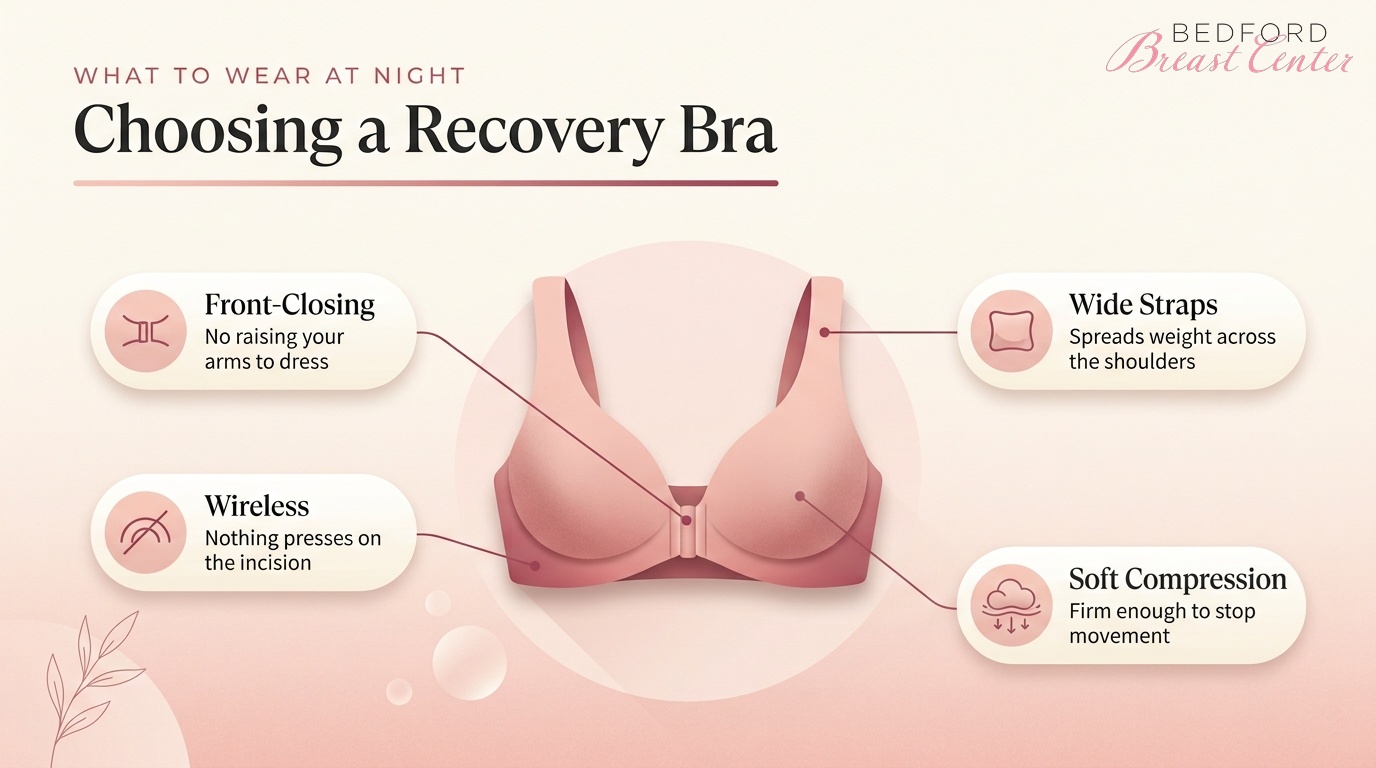
How long to sleep in a bra after a lumpectomy depends on how much tissue was removed.
A small incision may need support day and night for 2 to 3 days, while a wider excision or lymph node surgery can mean 2 weeks or more. Your surgeon sets the number at your post-operative visit.
The type of bra matters more than most patients are told:
- Front-closing, so you never raise your arms overhead to dress.
- Wireless, so nothing presses along the incision line.
- Soft compression, firm enough to stop movement without squeezing.
- Wide straps and full coverage, spreading weight across your shoulders.
A post-mastectomy bra works too, and dressing comfortably while you heal follows the same rules.
How to Set Up Your Bed for Recovery
Set your bed up in daylight, before you need it. Ten minutes now saves you standing in the dark later, so gather this first:
- A wedge pillow, or three firm pillows, for the 30 to 40 degree angle.
- Two arm pillows, one per side.
- A body pillow for when you start sleeping on your side after a lumpectomy.
- A knee pillow to stop you sliding down.
- Water and medication, caps already loosened.
- Phone and charger on your unaffected side.
- A nightlight you can switch on without twisting.
Those arm pillows matter most if lymph nodes were removed. Susan G. Komen's lumpectomy guidance notes the numbness and burning that follow, and that a small pillow underneath helps.
How Long Should You Rest After a Lumpectomy?
Plan on 1 to 2 weeks of genuine rest, followed by a gradual return. You usually go home the same day, so that first stretch happens at home rather than in the hospital, and the American College of Surgeons puts recovery from breast-conserving surgery at up to 1 to 2 weeks.
Rest here means limiting lifting and strain, not staying in bed. During those early days, expect breast pain, bruising, and numbness or altered sensation near the incision.
Notice too that this window covers surgical recovery, not full healing.
By around 4 weeks, you may feel close to your old self, though the months that follow are still doing quiet work underneath, and nerve sensations can take weeks or months to settle.
Everyone heals at a different pace, so how long to rest after a lumpectomy is a question for your surgeon, not a fixed number.
When to Call Your Breast Care Team
Most recoveries are uneventful. Normal soreness, bruising, and firmness ease each day, so treat anything that does the opposite as a reason to call:
- Fever or chills.
- Redness or swelling that grows instead of settling.
- Pus or discharge from the incision or biopsy site.
- Pain that worsens day by day instead of easing.
- Sudden swelling of the breast or arm.
- A firm area that expands rather than softening.
None of these automatically means something is wrong. Each still needs your care team to assess, not you to guess.
Is Your Bed Ready for Tonight?
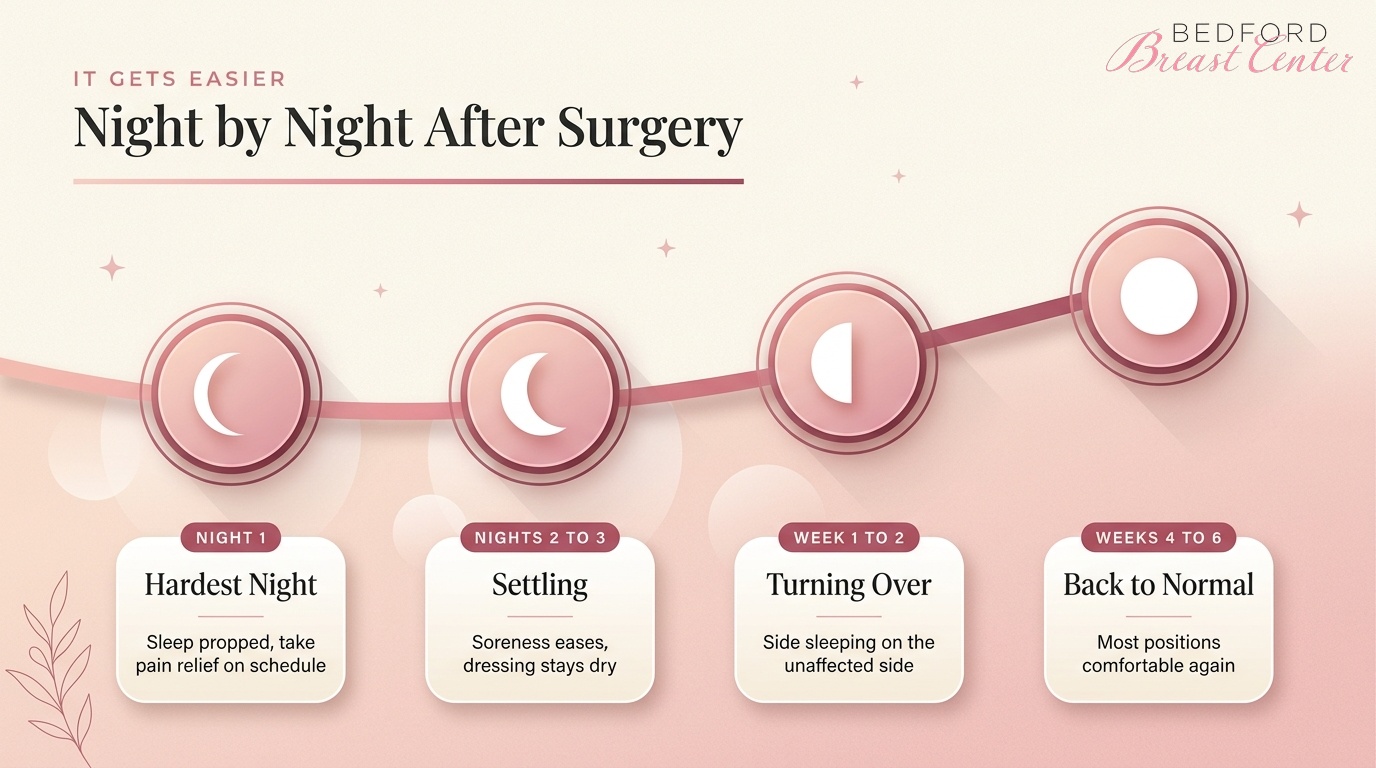
The best sleeping position after breast surgery is on your back, upper body raised 30 to 40 degrees, a pillow under each arm and one under your knees.
Hold it for 4 to 6 weeks after a lumpectomy, a night or two after a biopsy.
Most difficult nights turn out to be ordinary healing, though you should not have to decide that alone. Call (310) 278-8590 or message our Beverly Hills team, and your breast surgeons can often see you the same day.
FAQs
Can I sleep on my stomach after a lumpectomy?
No. Avoid stomach sleeping for 4 to 6 weeks after a lumpectomy, because lying face down presses directly on the incision and pulls at healing tissue. Hugging a body pillow while sleeping on your side after a lumpectomy gives a similar feeling until your surgeon clears you.
Do I have to sleep in a bra after a breast biopsy?
Yes, for the first night or two. A soft, wireless bra limits movement after a breast biopsy, which reduces soreness and bruising at the site. How long to sleep in a bra after a lumpectomy runs longer, often 2 weeks or more, because an incision needs steadier support than a puncture.
How many pillows should I use after breast surgery?
Use three to five pillows after breast surgery. Two or three behind your head and back build the 30 to 40 degree angle at the heart of the best sleeping position after breast surgery, one sits under each arm, and one under your knees. A wedge replaces the stack.
Why does my breast hurt more at night after surgery?
Your breast hurts more at night because pain sensitivity rises in the evening. A 2025 review in Frontiers in Neuroscience reports that nociceptive thresholds fall late in the evening and rise by early morning, alongside falling melatonin. Fewer distractions and lying flatter add to it, which is why elevation helps.
When can I sleep normally again after breast surgery?
Most patients sleep normally within 2 to 3 days of a needle biopsy and within 4 to 6 weeks of a lumpectomy. After a breast biopsy, your sleeping position stops mattering once the site is comfortable, while rest after a lumpectomy is usually 1 to 2 weeks.
